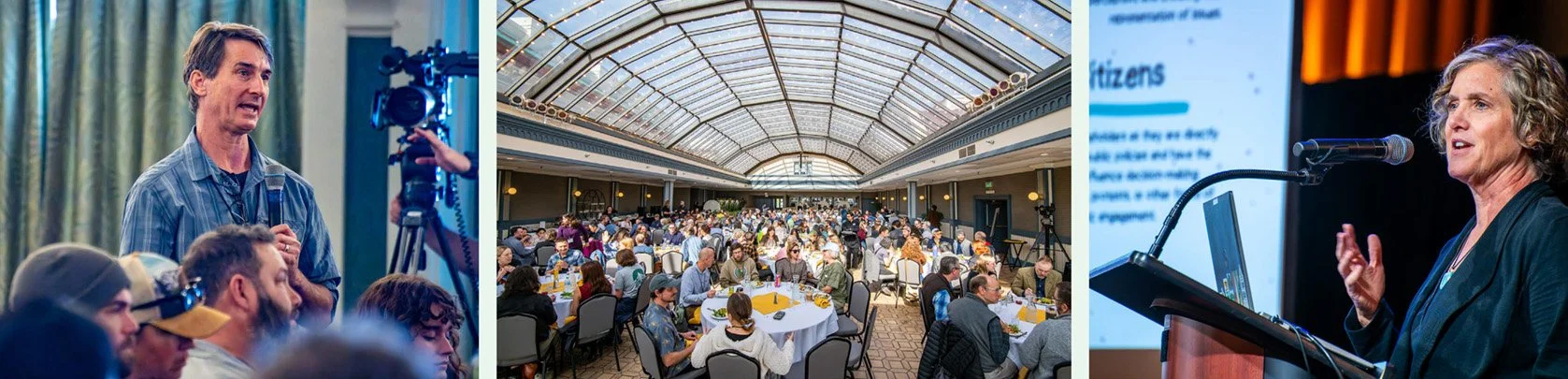
On January 30, 2026, the Santa Cruz Mountains Stewardship Network held the Science & Stewardship Symposium, bringing together more than 250 leaders working on scientific research and hands-on land stewardship in the Santa Cruz Mountains region.
The all-day program featured dozens of presentations and posters by Native Tribes, scientists, land managers, and policy makers. Also featured, were plenary talks by Don Hankins, Jennifer Norris, and David Ackerly.
The Santa Cruz Mountains are part of what is known as the California floristic province, one of 36 recognized biodiversity hotspots in the world due to its high diversity of plants and wildlife including dozens of rare and endemic species found nowhere else on earth. The Symposium brought many of the people who care for the land into the same place, giving them an opportunity to build relationships and share information.
Even if you missed the Symposium, the presentations and posters are now available here.
See below for reflections on the Symposium and what it meant to the land stewardship community.
Building a Network Across Generations
Jorge Ramos
Executive Director, Jasper Ridge Open Space Preserve (‘Ootchamin ‘Ooyakma)
The day was energetic from the very beginning. It felt like a much-needed event for the people of SCMSN who care about these landscapes. It was timely and full of hope, the kind that inspires action among friends. Having worked mostly in universities and field stations, I have always been a student of the field and of nature, while also focusing on building spaces and opportunities for students to get outdoors and explore future careers. I’ve also long been an advocate for stewardship. Recently, I even found some of my earliest public presentations from more than 15 years ago calling for more stewardship in academia. The symposium reminded me that I’m on the right track in my career, and that there is still so much work to be done but not alone, and not without friends.
I was excited to hear that a core message across all three plenary speakers was a call to action centered on stewardship. It reminded me that stewardship holds multiple timelines, values, careers, challenges, and pathways. Don Hankins’ foundational plenary called on us to practice stewardship across generations. His work, bringing fire back and slowing water, helped me think about our annual wins and the long-term marathon wins needed to rebuild the processes that create older, more resilient partnerships and ecosystems. Jen Norris strongly urged us to step up: to be willing to enter uncomfortable spaces, build science communication skills, and translate our work into real decisions. “Conservation needs us. Biodiversity needs us,” she said. David Ackerly pointed to a shift in our value system under the threats of climate change. We have to accept that there will be losses and transitions. He also underscored the urgency, not just to protect the past, but to come together and choose a future. Together, these talks left me with a stronger sense of shared responsibility, to think beyond our own lifetimes, many generations from now.
It can feel cliché to pull quotes, and I encourage you to re-listen to these talks. I want to be clear, these lines don’t summarize the speakers’ presentations. They are simply the phrases that stood out to me and helped me thread my own takeaway for SCMSN’s next steps:
From Don Hankins: “Active stewardship…it is a connection through a network of generations across.”
From Jen Norris: “Policy and science came together to allow us to do more stewardship in the landscape. We need to step up and be heard.”
From David Ackerly: “Science is a place to play; it takes all of us together to choose a path forward.”
I was also impressed by the Indigenous Knowledge and stewardship presentations that highlighted the power of Indigenous-led stewardship in the Santa Cruz Mountains. At Jasper Ridge ('Ootchamin 'Ooyakma), Bernadette Quiroz and Tadashi Fukami shared early “Two-Eyed Seeing” collaborations between the Muwekma Ohlone Tribe and Stanford. The “two-eyed seeing” activities support intergenerational community building across many fields, fire, botany, and language. Alec Apodaca and Esak Ordoñez described the Amah Mutsun Land Trust’s Integrative Stewardship Model, including collaborative archaeo-botanical research and stewardship in Quiroste Valley and other sites. Much of their work creates hands-on, intergenerational opportunities for young people to grow into their roles as stewards of the land.
As the day shifted to the breakout sessions, I moved to my assignment. As moderator of the Prescribed Fire session, I learned about practical site-preparation and understory burn methods from Spencer Klinefelter, new experimental designs to study prescribed broadcast burns from Ian Cook and Georgia Vasey, and gained new perspectives on smoke, policy, and public health from Arjan Walia. The number of questions—and the follow-up conversations—highlighted both the growing interest and the urgency to continue bringing good fire back through stewardship and science. The session sparked new connections and ideas that can help the SCMSN community plan and implement burns, share best practices, apply adaptive management, and study future prescribed and cultural fire in the region.
The poster session was loud, in a good way, with the kind of energy you get when people who usually work outdoors are suddenly inside, excited to share their science and stewardship practices. With more than 20 posters spanning topics from fire to wildlife, rare plants, carbon, invasive species, and new monitoring tools, presenters showed how stewardship is becoming more integrated with research and more collaborative across organizations. It truly felt like a network at work: universities, agencies, nonprofits, students, practitioners, and researchers sharing methods and results and hopefully, finding new ways to partner on the next generation of stewardship projects.